
With this burst of home games I decided to combine Wycombe and Wigan into one article, and throw in a bit of turmoil and dissent as well.
Doing my research I have found more links between us and Wycombe than I thought existed, although even then I am not suggesting this is a comprehensive coverage.
I have written before about our first meeting with “The Chairboys”, an FA Trophy second round tie at Town Meadow on 18th January 1986. This was the first time we had actually reached the proper rounds of the competition since its inception in 1969, an achievement partly due to us receiving a bye through to the third qualifying round for the first time (due to our high finish in the previous season’s Southern League Premier Division, when we finished third to Cheltenham Town and King’s Lynn).
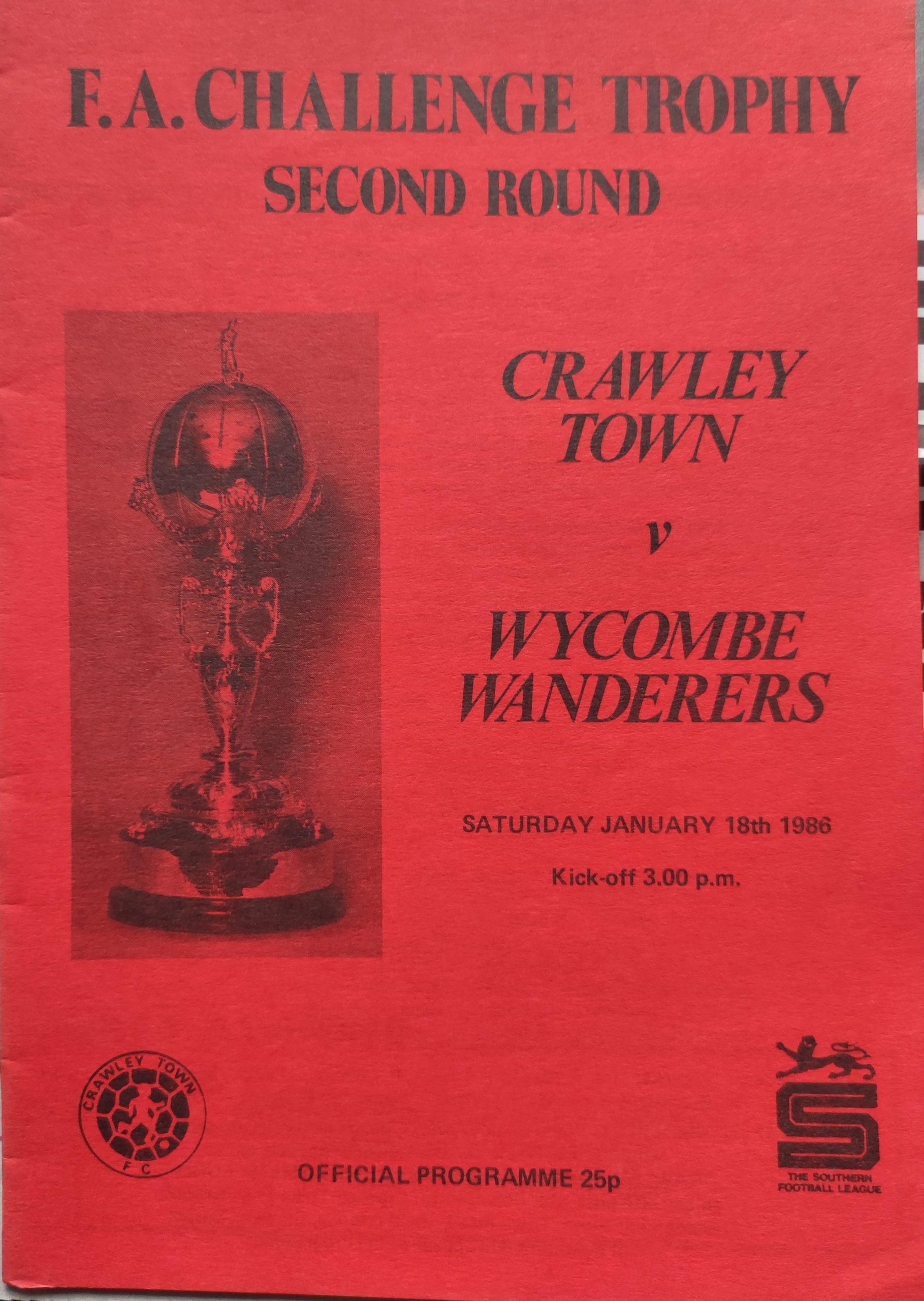
FA Trophy 2nd Round Wycombe 1986
We had managed a fine 3-0 win at Farnborough (second in the Isthmian League Premier Division at the time) on 30th November 1985 in that third qualifier before despatching fellow Southern League Premier Division Worcester City by 5-2 on 21st December 1985 in front of 756 fans to set up the Wycombe game.

1986 FA Trophy 5-2 v Worcester
Sadly our run came to an end against a very strong Conference side in front of a decent crowd of 1,250 at Town Meadow. We did have a chance to get back into that game but missed a second-half penalty to seal our fate. Despite there being no other meetings between the two clubs for several seasons, I did find an interesting Observer headline from 3rd May 1995, in which future Red Devils player-manager Colin Pates declared as part of his bid for the job, “I’ll Make Reds A New Wycombe.” He did indeed get the job, but as for following Martin O’Neill’s lead at Wycombe and leading Crawley into the Football League, that turned out to be a bit optimistic, and he left his role as manager the following year.
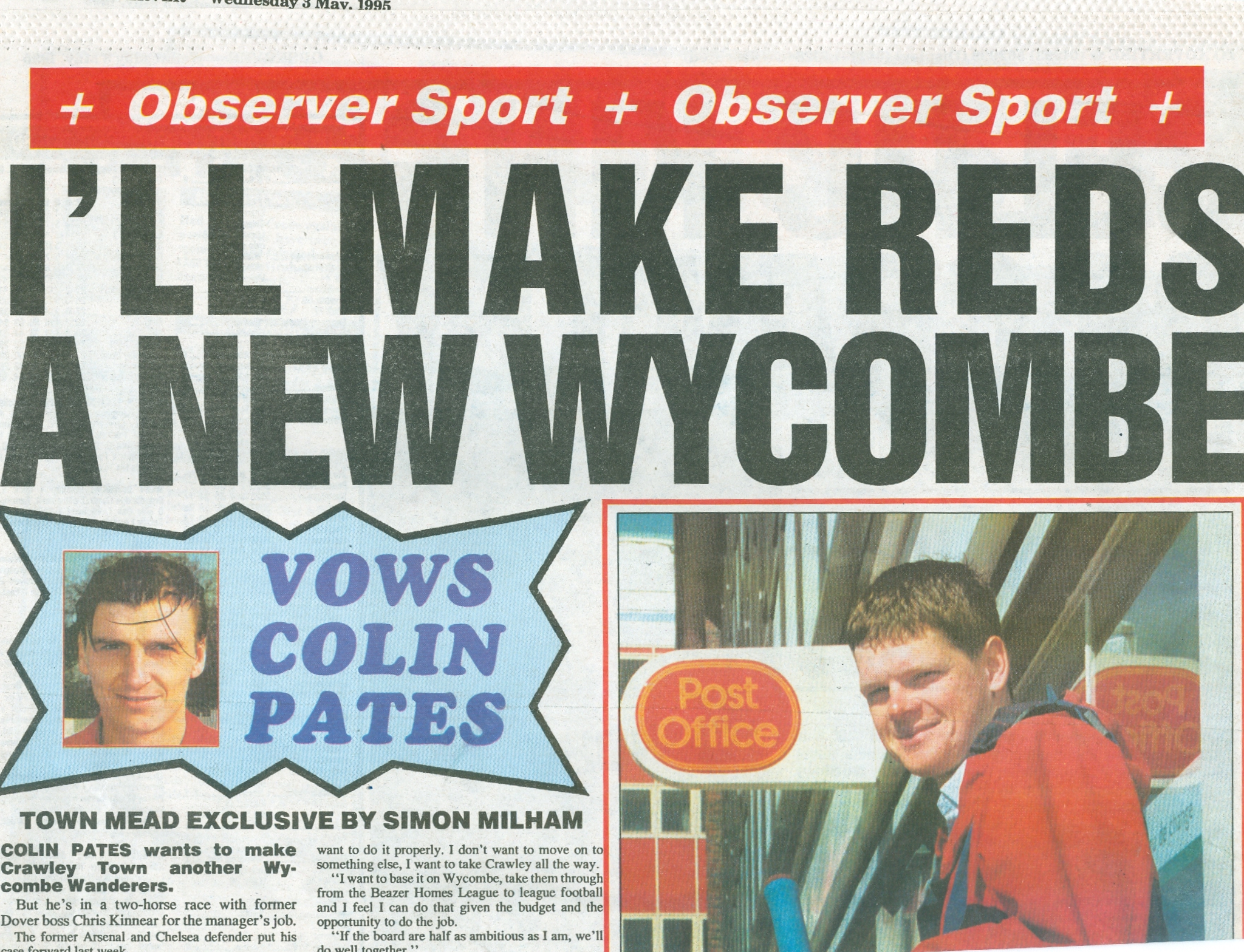
1995 Pates “I Will Make Reds a New Wycombe”
We would have to wait for the turn of the millennium before our two clubs met again, and this time a pre-season friendly at Broadfield on 8th August 2000. It would also be our introduction to future all-time Red Devils club legend Dannie Bulman, who was in the Wycombe squad having joined them in 1998. And Dannie would make an appearance as a substitute when we played them in another pre-season match the following season on 22nd July 2001 and beat them 3-2.
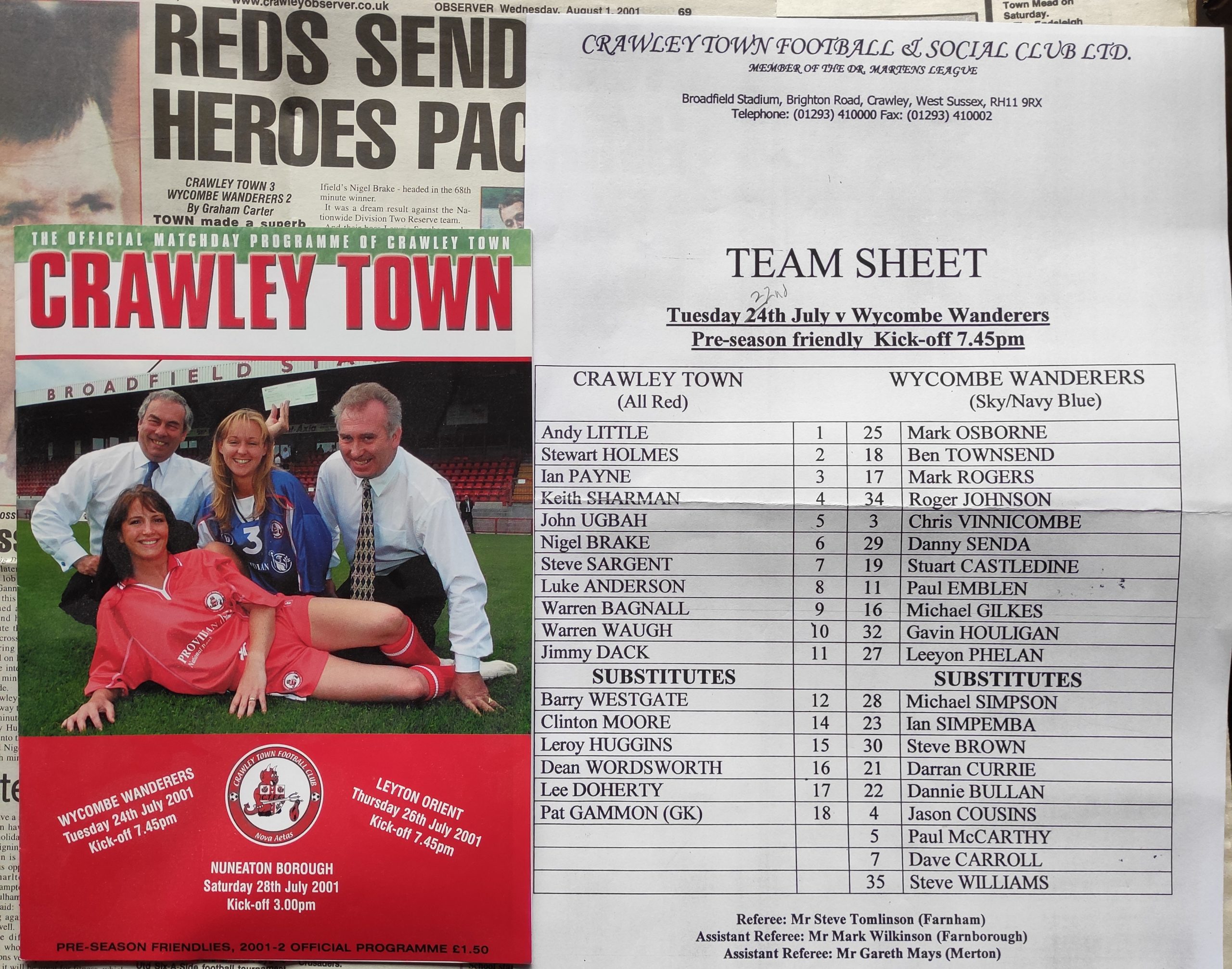
Wycombe PSF July 2001 Team Sheet

Wycombe PSF July 2001 – prone Dannie Bulman
From the picture of Dannie face down on the Broadfield turf, it would appear he was as committed then as he would be to us throughout a distinguished career with the Red Devils. Wycombe actually took a 2-0 lead in that game through future Red Devils loanee Gavin Holligan (or ‘Houligan’, according to our team sheet, which also listed Bulman as Bullan), but we stormed back through new signing Warren Waugh and equalised through Broadfield’s own Clinton Moore before another local player, Nigel Brake, headed home a 68th-minute winner in front of 804 fans.
Dannie played over 200 games for Wycombe and appeared in Wycombe’s amazing run to the FA Cup semi-final as a Second Division club the previous season. He played in that semi-final match at Villa Park against mighty Liverpool in April 2001, only losing 2-1, just days after Liverpool had drawn 0-0 with Barcelona in the Nou Camp.

Dannie Bulman v Liverpool FA Cup Semi Final April 2001
There would be other links between our clubs: Steve Wicks, who managed us (briefly) in 1992, playing Conference games for Wycombe in 1989/90; John Gregory would manage both clubs; and players such as Ian Simpemba and Mo Harkin, amongst others, would play for both sides. However, the main name that springs to mind after Dannie Bulman is another considered an all-time legend at both clubs, one Sergio Torres, who played for Wycombe from 2005 to 2008 before joining Peterborough, from where we signed him in 2010 (for an undisclosed fee possibly £100k!). Sergio would go on to endear himself to the Red Devils faithful in the same way he has done at all of his clubs, as much for his personality and attitude as for footballing highlights such as his winner against Nigel Clough’s Championship side Derby County (pictured).

Sergio and that magic scoreline against Clough’s Derby 2010-11
Moving on to Tuesday night’s opponents, Wigan Athletic, who, like Wycombe, were a major force in non-league football until their entry into the Football League in 1978. Our paths crossed for the first time on 4th November 2017 when the Red Devils, under manager Harry Kewell, made the long trip to the Northwest for an FA Cup first-round tie. It was about as tough a draw as we could have, with Wigan second in League One, on their way to promotion back to the Championship. One hundred and fifty-seven hardy Red Devils fans made the trip and saw us take the lead through a spectacular Jordan Roberts effort in the first half. Unfortunately we couldn’t hold on and would eventually lose 2-1, with one of the Wigan goals scored by Ivan Toney, giving some idea of the quality of opposition we faced. Also in the Wigan squad was Nathan Byrne, who as a youngster played several games on loan to Crawley from Tottenham in the 2012-13 season.
Of course a more recent old boy should be back today, and welcome back Ronan Darcy – but hopefully he can see what he has given up!
I always knew Wigan were a top non-league side in the 1970s – maybe the northern equivalent of the dominant Wimbledon side of the time? – but I had a sift through some of their history on Wikipedia to look a bit further back.
Many know that Wigan is a major rugby league town, but it seems that it has always had a solid core of football fans trying to keep the sport alive there. Amazingly, Wigan Athletic were formed in 1932 as the sixth attempt to try to establish a senior football team in a rugby league town. Previously it has been known as AFC (very modern that one?), County, United, Town and Wigan Borough, all of which failed, but Athletic, who took over Borough’s Springfield Park ground, made their appearance in 1932 and joined the Cheshire League, making the first of 34 applications to join the Football League before finally replacing Southport in 1978.
Wigan were still playing at Springfield Park in their early Football League campaigns and were averaging crowds over 6,000, but after some ups and downs, by 1995 they were near the bottom of the old Fourth Division, with crowds averaging 1,800. Enter Dave Whelan in 1995, and a stay in the Premier League and an FA Cup win followed, along with a shiny new ground and enhanced attendances, which shows what can be done with a friendly local billionaire (some parallels with that lot from Falmer?). Sadly since those heady days, under various ownerships, they have had less success and more financial issues.
I mentioned earlier our FA Trophy run of 1985, and I remember watching Wigan losing 2-1 to Scarborough after extra time in the final at Wembley in 1973 in front of a 23,000 crowd. I even have the programme somewhere as I used to go the final regularly in the early 1970s.
Out of interest, I checked out how close we had come to Wembley that fourth season of the competition, and as usual at the time, it was not very far. That 1972/3 season had started badly for us, with a significant level of dissent being shown by younger fans, which all came to a head in a Southern League Cup tie at Met Police (we lost 6-1 and were dreadful). Following that, a dire warning of consequences was printed in the programme for the second leg of the tie. The programme editor acknowledged that the season had started badly, but that the levels of abuse were offending “normal people” and bans would occur if it continued.
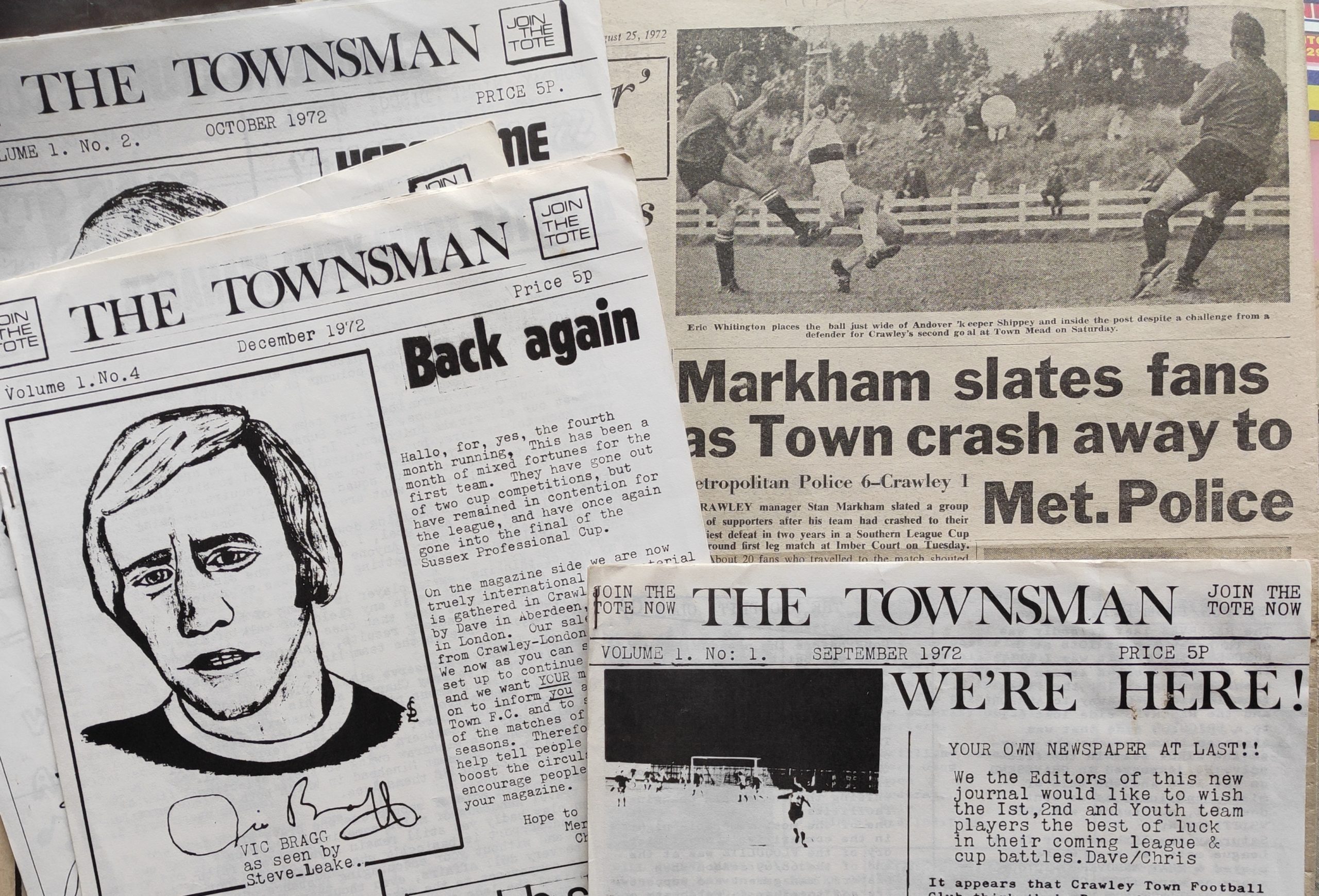
1972/73 “Disgraceful Fans” and our first Fanzine!
Supporters had started up our first fanzine, The Townsman, for which Steve Leake was the resident artist and music contributor. But, it seems from a programme comment, that the fanzine too seems to have offended the club! Having been at the 6-1 defeat and also the 4-0 defeat at Bletchley Town (forerunners of Milton Keynes) the game before, I remember feelings running pretty high. Some of this anger was a throwback to us selling our star goal-scorer Phil Basey to Maidstone United, breaking up his highly successful partnership with Eric Whitington.
Amazingly – and despite the finances of the club starting to run low – a few weeks later we found ourselves top of the table and managed a 3-2 win over Met Police in the first qualifying round of the FA Trophy at Town Meadow. We were drawn away to Bath City in the next round, and having played them in a fiery game at Twerton Park the week before, went looking for revenge. Sadly we were 3-0 down after 23 minutes, and despite goals from Steve Cosham and Whitington we couldn’t find an equaliser. The match ended with both sides down to ten men as Jock Munn was sent off with a Bath player after a punch-up. Jock was a nice chap, but on the field made Jay Williams appear to have the temperament of Mother Teresa.
Our chances – and the club’s finances – slipped away as that season progressed, with the sale of Whitington to Folkestone just after Christmas the final nail in the coffin of our promotion hopes. Things reached a new low with a 7-0 home defeat to Ashford at Easter 1973, a sign of things to come for the next few seasons.
Some might see a few parallels to more recent times. I am not sure, but maybe it helps makes some of us older fans a bit more philosophical about the ups and downs? (Who am I kidding . . .)
Come on, you Red Devils!
Mick Fox – mjfjo@yahoo.co.uk

0 Comments