
I realise that many of our EFL opponents have “come up through the ranks”, as it were, from non-league football throughout the 20th century, but for the purposes of this and recent articles it is since our entry into semi-professional football as a Southern League club in the 1963/64 season that I use the term “ex non league”.
Our recent run of matches at Broadfield against ex non-league sides, starting with Stevenage, then Wycombe and Wigan (and Burton Albion in January), comes to an end this weekend against another in Cambridge United.
In fact of the aforementioned group of teams, Cambridge United are the longest-serving Football League side, gaining election into the League in 1970 after winning the Southern League Premier division title in both 1968/69 and 1969/70.
Cambridge would replace Bradford Park Avenue as part of the end-of-season process whereby the bottom teams in the Football League had to compete against aspiring non-league clubs for their place in the league. The “old boys’ network” tended to keep the Football League a fairly closed shop, but Cambridge United’s status as the premier non-league side in the country over the previous two seasons meant Bradford PA would lose their Football League status after over 60 years of membership.
I hadn’t realised until researching this article that Bradford PA had originally tried to join the Football League in 1907, but were rebuffed, and instead would join the Southern League to replace Fulham, who joined the Football League. Now, no matter how good or bad your UK geography, I think most people realise that the city of Bradford is not in the south of England, but join the Southern League they did, though for one season only as they would gain entry into the Football League in 1908.
Back to Cambridge United (I have to keep adding the ‘United’ tag as there is another club in the city called Cambridge City, who in the past were arguably as big as – or bigger than – Cambridge United) and we would first come up against them in that 1969/70 season, what would turn out to be their last in the Southern League, when we were promoted to the Premier Division after a fourth-place finish in Division One in 1968/69.

Crawley 0 Cambridge United 2 September 1969
Our first meeting was at Town Meadow early in that 1969/70 season, on 10th September 1969. We had an acceptable start to the season (bearing in mind this was the top level of non-league football at the time) and were in mid table, having started the season at Poole Town with a 2-2 draw (Colin Blaber, 2), and followed it with a 0-0 home draw with Romford before gaining our first win, on 16th August, 4-2 (Tony Kingston, 2, Dave Cockell, 1, OG) at home to King’s Lynn. We did then lose a very tight game 1-0 away to Hereford United on 23rd August 1969, but when you find out the scorer was the world-famous John Charles, it gives some idea of the level we were playing at.
Sadly we would fall to a 2-0 home defeat to Cambridge United in front of a decent crowd of 1,565 at the start of an extremely difficult spell for the Red Devils. I noticed, though, that we did pick up a good point a week later in a 3-3 draw (Phil Basey, Dave Haining, Tony Goodgame) at Yeovil Town and would then make a hurried dash to catch our train home. The details of our dash for the train were in our next home programme (Worcester City, lost 1-0), which confirmed that the game ended at 4.38 p.m. and despite the station being four miles away, with the help of a fleet of taxis, the team managed to make the 5.15 train (still in their muddy gear?)!
We did manage a couple of home wins in October against fellow strugglers Nuneaton Borough (3-2: Goodgame, 2, Derek Tharme) and Poole Town (2-0: John Leedham, Basey), but these would be the last victories in the league until 14th March (Brentwood 2-1: Charlie Livesey, Basey, at Town Meadow)!
Heavy defeats at Bath City (1-6: Basey) on 6th December and Weymouth at home (1-5: Basey) on 9th December preceded what was one of my all-time low points watching the Red Devils when on 13th December we would lose 0-9 at Wimbledon just weeks after we had taken them to a second replay (remember them, Football Association?!) in the FA Cup fourth qualifying round.
Surprisingly, when we came up against Cambridge United in the return game at the Abbey Stadium on 7th February 1970, it was on the back of an excellent 1-1 draw (Dave Haining) with Wimbledon at Town Meadow the previous week. And that came just days after being thrashed 2-6 (Derek Leck, Blaber) at Kettering Town.
Unfortunately that scoreline would appear respectable alongside an 0-8 capitulation against Cambridge United, when our tiny squad was stretched to breaking point against one of the richest clubs in non-league football at the time.

Cambridge 8 Crawley 0 February 1970
Only three more wins that season would see us finish second bottom of the Premier Division (Burton Albion were bottom, with only fifteen points), with 101 goals conceded to totally deflate a support that had been on such a high after promotion in such unexpected circumstances (tiny squad and budget) the previous season. I don’t want to tempt fate, but that scenario is starting to look very similar to the present day, maybe without some of the high-scoring defeats.
Although we came up against Cambridge City often in the intervening years of Southern League football, we would not meet Cambridge United again in a competitive game until our second season in the Conference, 2005/06, after their relegation from the EFL.

October 29th 2005 Cambridge Utd 2 Crawley 1
That game at the Abbey Stadium on 29th October 2005 came at a turbulent time for the Red Devils, with us lying third from bottom of the Conference (Burton Albion below us again, though!) and having just been knocked out of the FA Cup by Braintree of the Isthmian League 1-0 at Broadfield.
This defeat seemingly was the final straw, and highly successful manager Francis Vines was dismissed, with our midfielder Simon Wormull taking on the caretaker manager role for the Cambridge game. This unfortunately did not change our fortunes immediately and we would lose a pretty poor game 2-1, our goal coming from Jamie Cade.
By the time the return match at Broadfield was played on 25th March 2006, our league position had improved slightly but we were still in a precarious position under our new manager John Hollins, and had just relinquished our Sussex Senior Cup crown the previous week to John Maggs’s Horsham in the semi-final at Worthing.
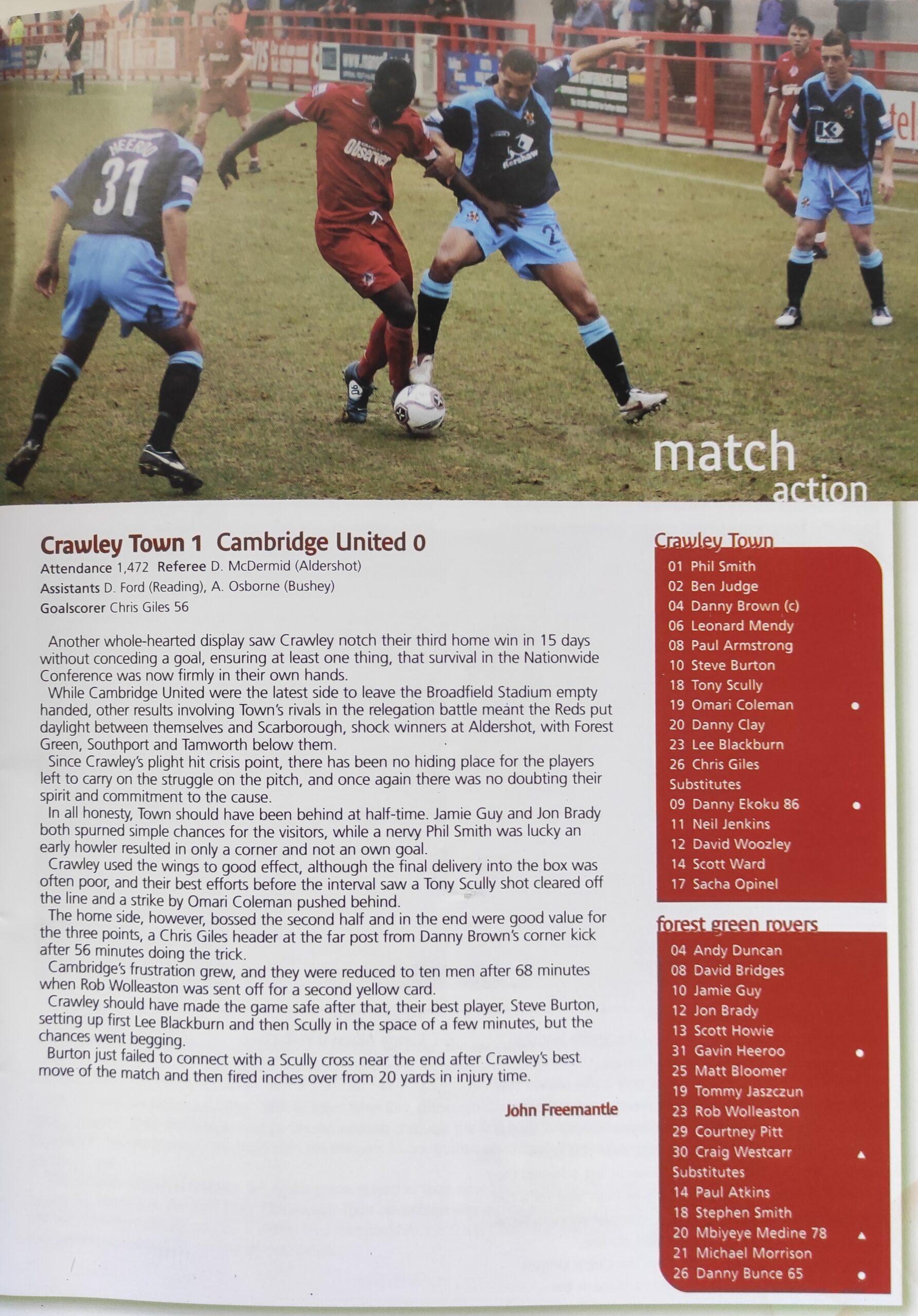
25th March 2006 Cambridge United Report
Happily this did not dent our confidence and we managed to battle to a 1-0 win (Chris Giles), our third home win in two weeks.
We did comfortably manage to avoid the drop that season despite again having a small squad and suffering severely with injuries at times. We also had Reggie writing a column in the programme for us towards the end of that season, and in my opinion, Reggie has never looked better than he did in those early days!

Reggie the Red Devil
After several seasons of opposition in the Conference we would have our first EFL meeting with Cambridge United on 22nd August 2015 when we ran out 3-0 victors (Roarie Deacon, 2, Gwion Edwards) at the Abbey Stadium (see programme report of game).
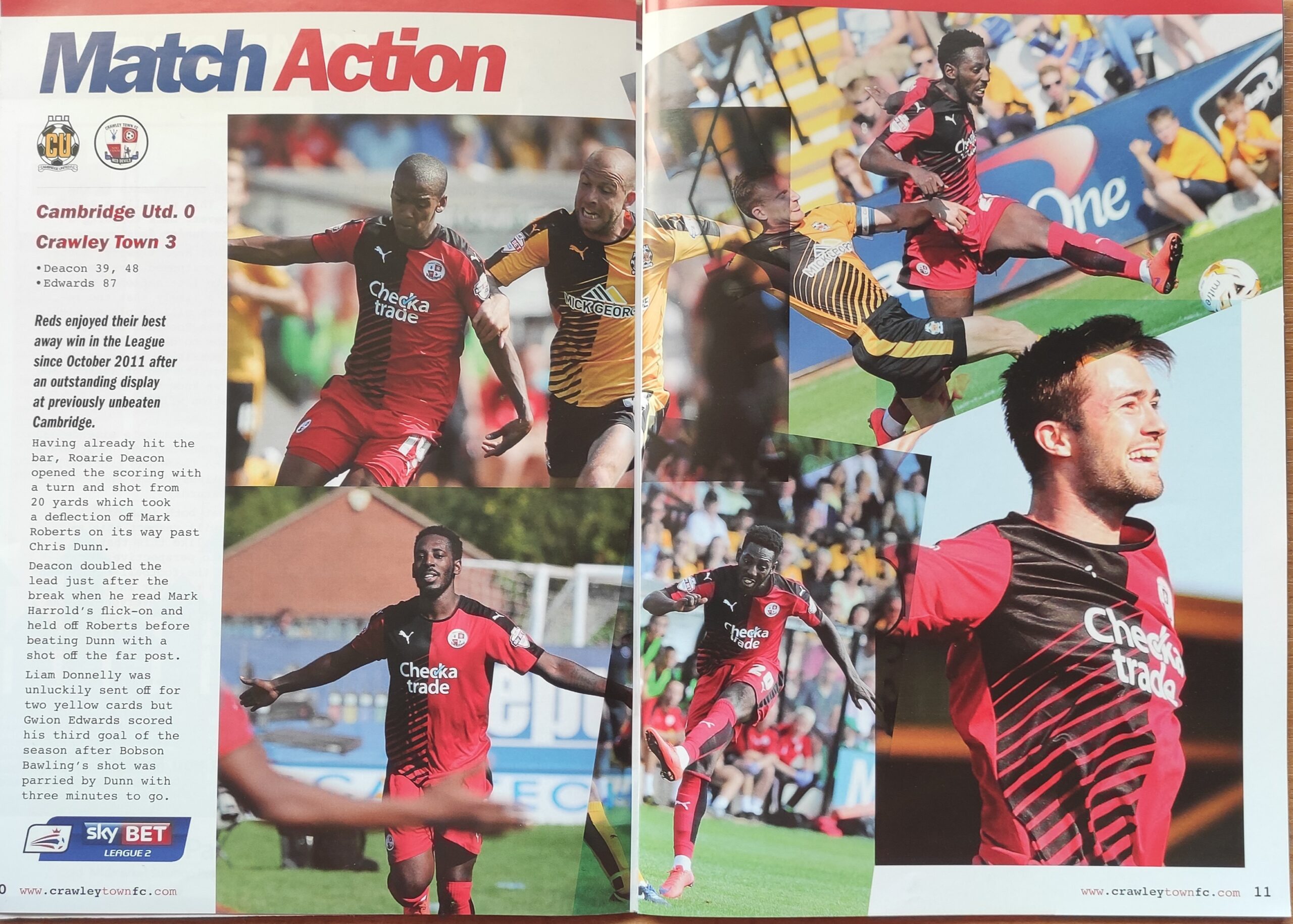
2015 A fine 3-0 away win
And under manager Mark Yates we even managed a league double over Cambridge United, winning the return at Broadfield on 9th January 1-0 thanks to a Matt Harrold goal.

2016 1-0 win and a league double
The previous week we had played away at Portsmouth on 2nd January and although we lost 3-0, our decent away following of 567 was in fine voice all game. So much so that our programme for the Cambridge game featured a double-page spread of a section of that support. Anybody recognise themselves?

Crawley fans at Pompey Jan 2nd 2016 Recognise anybody?
Finally, on a sad note, I recently wrote about our supporters football team of the 1970s, Town Mead Wanderers, one of whose remaining members died this week. My old team mate Stuart Ormanroyd was a regular at the Broadfield even when suffering from an extremely serious illness, and as recently as the Burton game was here with his brother Del (also a Town Mead Wanderer), despite being very unwell.

“Memories” Stuart Ormanroyd – Aylesbury 6-0 away win
I managed a bit of Red Devils reminiscing with Stuart after the match and uncannily we both brought up simultaneously memories of us attending a 6-0 away win (Wayne Peacock, 3, David Gates, Tony Mulhearn, Ian McGonagle) at Aylesbury on 26th October 1976. Just as remarkably, that game was 0-0 at half time. In the second half we were right behind the end where all the goals went in. Happy memories! RIP, Stuart, and condolences to his wife Linda and to Del and the rest of the family.
Mick Fox – mjfjo@yahoo.co.uk

0 Comments